
Master Beginner Yoga Poses: A Step-by-Step Guide to Essential Techniques
Yoga is a practice that harmonizes the body, mind, and spirit. It can improve flexibility, build strength, and reduce stress. For those just starting their yoga journey, understanding the basics is essential. Today, we delve into “Master Beginner Yoga Poses: A Step-by-Step Guide to Essential Techniques,” a primer designed to help novices build a strong foundation in their yoga practice.
Introduction to Beginner Yoga Poses:
Embarking on a new fitness journey can often be daunting, but yoga offers a gentle introduction. Master beginner yoga poses require patience and practice. These foundational poses not only prepare the body for more advanced practices but also introduce practitioners to yoga’s mental and physical benefits.
Step-by-Step Guide to Essential Yoga Techniques:
-
Mountain Pose (Tadasana)
- Purpose: Forms the base for all standing poses; improves posture, balance, and calm focus.
- Technique:
- Stand with feet together, arms at sides.
- Distribute weight evenly across the soles of your feet.
- Engage your core, inhale, and reach your arms towards the ceiling, palms facing each other.
- Breathe deeply while drawing your belly button into your spine.
-
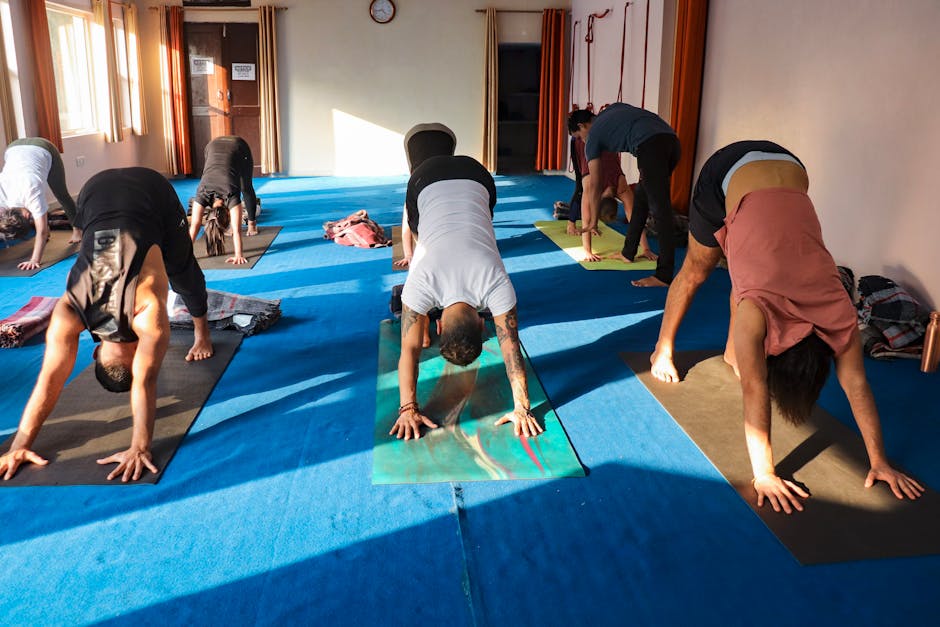
Downward-Facing Dog (Adho Mukha Svanasana)
- Purpose: Stretches the shoulders, hamstrings, calves, arches, and hands; strengthens arms and legs.
- Technique:
- Start on your hands and knees, with your wrists under your shoulders and knees under your hips.
- Spread your fingers wide and press your hands into the mat.
- Exhale as you lift your knees off the floor and straighten your legs, sending your hips up and back.
- Hold and breathe, trying to press your heels gently towards the floor.
-
Warrior I (Virabhadrasana I)
- Purpose: Strengthens legs and arms; improves focus and balance.
- Technique:
- Begin in Mountain Pose, step your feet about 4 to 5 feet apart.
- Raise your arms perpendicular to the floor and parallel to each other.
- Turn your left foot in slightly to the right and your right foot out 90 degrees to the right.
- Align the right heel with the left heel.
- Exhale and rotate your torso to the right, squaring the front of your pelvis as much as possible with the front edge of your mat.
- Bend your right knee over the right ankle so that the shin is perpendicular to the floor.
- Hold for up to one minute. To release, inhale as you straighten your right leg and lower your arms.
-
Tree Pose (Vrksasana)
- Purpose: Strengthens the thighs, calves, ankles, and spine; improves balance and concentration.
- Technique:
- Start by standing in Mountain Pose.
- Shift your weight slightly onto your left foot, keeping your inner foot firm to the floor.
- Bend your right knee, then reach down with your right hand and clasp your right ankle.
- Draw your right foot up and place the sole against the inner left thigh; avoid placing the foot against the knee.
- Press your hands together in prayer position at your chest and gaze softly at a fixed point in front of you.
-
Child’s Pose (Balasana)
- Purpose: Restorative pose that gently relaxes the muscles on the front of the body while softly stretching the muscles of the back torso.
- Technique:
- Start on your knees with your feet together and buttocks resting on your heels.
- Separate your knees about hip-width apart.
- Exhale and lay your torso down between your thighs.
- Lay your hands on the floor alongside your torso, palms up, and release your shoulders toward the floor.
- You can hold Child’s Pose for up to a few minutes.
FAQs about Master Beginner Yoga Poses:
Q1. How long should I hold each yoga pose?
A1. As a beginner, start by holding each pose for about 20-30 seconds or a few breaths. As you gain more experience, you can extend the duration.
Q2. How often should I practice these beginner yoga poses?
A2. Aiming for 2-3 times per week is a great start. As yoga becomes a more integral part of your life, you might find daily practice beneficial.
Q3. What should I do if I find a pose too difficult?
A3. Always listen to your body. If a pose causes pain, try modifying it or using props like yoga blocks or a strap to help maintain alignment without straining.
Q4. Can I do yoga if I’m not flexible?
A4. Absolutely! Yoga is not about being flexible but about strengthening your body and increasing your flexibility over time.
Conclusion:
Master beginner yoga poses are not just exercises. They are techniques that introduce you to the integrity of yoga, incorporating breathing, focus, and movement. Use this “Master Beginner Yoga Poses: A Step-by-Step Guide to Essential Techniques” as your blueprint to the fascinating world of yoga. Remember, the goal of yoga is progress, not perfection. Enjoy your journey towards health, mindfulness, and inner peace. Namaste!